

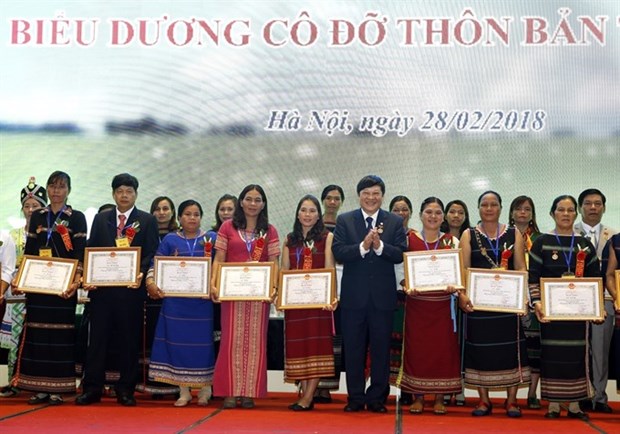
 Village midwives honoured at the ceremony on March 7 for excellence achievements in protecting and caring for mother and children’s health. (Photo: VNA)
Kon Tum (VNS/VNA) – Old habits die
hard, but , 38, from Dak Sao commune in the Central Highlands province of
Kon Tum’s Tu Mo Rong district is determined to make a difference in in her village’s.
“Being a woman, I understand how pained and
worried women may be when they give birth. During this period, we need care and
sympathy from relatives and experienced people. But most of the people believe
in giving birth naturally without assistance,” she said.
Lack of during
childbirth results in frequent deaths of both mothers and children.
An opportunity to bring change came to Ngoc
in 2009 when she was sent to attend a training course under the “Midwife
in the Village” programme implemented by Ho Chi Minh City-based Tu Du Hospital.
The popular programme has helped to improve reproductive health care for women
in remote areas in the Central Highlands by training women to work as midwives
to assist during childbirths. Designed by Nguyen Thi Ngoc Phuong, director of Tu
Du Hospital, the initiative also provides the new midwives with necessary
equipment.
Midwives are taught to examine and monitor
fetal development and assist in delivery at health clinics.
Dak Sao commune, where Ngoc resides, is one
of the most disadvantaged in the Central Highlands. Its population of about
3,198 people are mostly Sedan ethnic minority people.
Due to the long distance from the commune
to the district’s centre (about 33km), traditional medicine and beliefs have
not yielded to modern medicine.
Pregnant woman rarely go to health clinics
for check-ups. Many people prefer giving birth at home; they think that
delivery at health clinics is embarrassing because there are many people
witnessing the delivery. In addition, visiting the clinics is expensive.
“In the past, maternal mortality and child
mortality were high in the province. There were difficult deliveries due to
cervix problems. In other cases, the newborn could not breathe and then died or
the mother had hemorrhage,” said Nguyen Thi Dieu Anh, deputy director of Kon
Tum province’s Reproductive Health Care Centre.
Many consequences were caused by delivering
at home without the assistance of trained health workers, she said.
Y Lon, a resident from Dak Sao commune,
said that in the past, pregnant women didn’t receive any support from their
family.
Y Bop, another local resident, agreed:
“Previously, when a woman had labour pain, some day do (red creepers) would be
brought home from forest which was then applied to make her skin smooth.”
“There would be a rope hung above for her
to hold and she would kneel to give birth,” she said, adding that two or three
years ago, such delivery practices were common and no one assisted the mother.
But everything has changed since Ngoc
returned to her homeland as a village birth attendant.
Old customs have been replaced by updated
knowledge on reproductive health care skills that Ngoc grasped during her
18-month training course.
“I provide counseling to women in the
village on the risks of unsafe delivery. I advised pregnant women to visit
communal health clinics for check-ups and delivery for the safety of both
mother and their babies,” Ngoc said.
Apart from performing antenatal care for
and assisting deliveries, she also took part in communication activities to
promote safer health practices in the community.
Ngoc called on local residents to use
condoms or other contraceptive methods so that their children would receive
better care and they have more time for themselves.
Thanks to her efforts, the number of women
who give birth to a third child has been reduced from 35 percent in 2009 to 8.7
per cent last year.
The rate of pre-natal check-ups increased
from 50 percent in 2009 to 93 percent in 2017, while the rate of delivery in
health clinics increased from 20 percent in 2009 to 60.9 percent in 2017.
“Pregnant women now go to clinics regularly
to examine the fetus and vaccinate children,” she said proudly.
With her contributions, Ngoc received the
certificate of merit from the Ministry of Health and was among 66 village birth
attendants honoured at the ceremony for excellent achievements
in protecting and caring for maternal and children’s health held late last month.
Ngoc said she has delivered almost 100
babies to pregnant mothers who cannot afford to travel to the nearest health
centres over the past eight years.
She still remembered the first delivery she
assisted.
One day, a husband told her that his wife
went into labour. When she arrived, she saw that the baby’s head was going to
be out. At that time, she was afraid that the mother would be infected but she
tried her best to help her until she finished the birth safely.
After that, the family was very grateful to
her and she felt happy.
“At first, villagers didn’t trust me but
then some pregnant mothers gave birth safely with my assistance. They were
satisfied and trusted me more and gradually I gained a reputation,” Ngoc said
with a big smile.
Theu Hai Xuan, a local resident, said: “My
neighbours have given birth with the assistance of Ngoc. My sisters also had
her support so I believe her. She is very dedicated.”
According to Ngoc, the biggest concern of
most village birth attendants is that they haven’t received financial support
from the Government although they have undergone training and worked for a long
time.
Training courses should be organised
regularly with a view to enhance the knowledge and professional skills of
village birth attendants.
She hoped that the problems would be solved
so that they could make more contributions to the health care service for
mother and child.
“I
love this job very much. I will try my best to help villagers so that there
will be no more maternal and neonatal deaths.” – VNS/VNA
Source: VietnamPlus


