
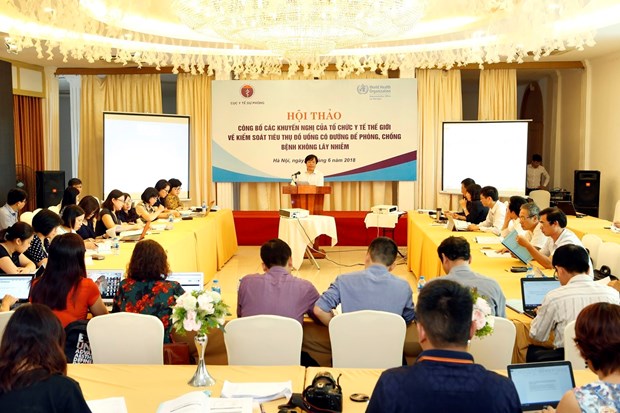
 The workshop on June 22 announces the WHO’s recommendations for controlling sugar-sweetened beverages to prevent non-communicable diseases (Photo: VNA)
Hanoi (VNA) – Each
Vietnamese currently consumes about 46.5 grammes of every day, which
is close to the maximum daily intake of 50 grammes and almost doubles the recommended
daily intake of under 25 grammes.
The information was revealed at a workshop in
Hanoi on June 22 that announced the World Health Organisation (WHO)’s
recommendations for controlling sugar-sweetened beverages to prevent
(NCDs).
Deputy Director of the Health Ministry’s
Department of Preventive Medicine Truong Dinh Bac said an unbalanced diet with
much salt, sugar-containing products and saturated-fat and little vegetables
and fruits, along with a lack of physical activities are risk factors of NCDs.
Notably, the consumption of sugar-sweetened beverages is growing, especially in
developing countries, he said.
In Vietnam, overweight and obesity rates are
increasing rapidly, he noted, elaborating that about 25 percent of the adults
are overweight or obese. The rate of obese children under five years old soared
from 0.6 percent 2000 to 5.3 percent in 2015.
According to the National Hospital of
Endocrinology, the rate of persons with diabetes doubled from 2.7 percent in
2002 to 5.4 percent in 2012. The lifelong care for and treatment of these
patients will be a burden on the economy.
At the workshop, a WHO representative said
are the main source of sugar in meals, and the
consumption of these drinks has been on the rise on almost all nations and,
especially, among children. If a child drink a can or bottle of sugar-sweetened
beverages in one day, his or her intake of free sugars has been much beyond the
recommended level as one can of soft drink usually contains about 36 grammes of
free sugar.
The WHO recommended that the intake of free
sugar, including monosaccharides and disaccharides added to
foods, or sugar naturally present in honey, syrups, and fruit
juices should account for not higher than 10 percent of each person’s diet and
be reduced to 5 percent of the daily calories, equivalent to about 25 grammes
of free sugar or six teaspoons.
The WHO urged countries to boost communications
to raise public awareness of sugar-sweetened beverage consumption and control
the advertising of these products, especially at schools. They also need to
encourage producers to put health warning labels on sugar containing products
and hike tax on these products to raise budget revenue and limit abuse.-VNA
Source: VietnamPlus


