

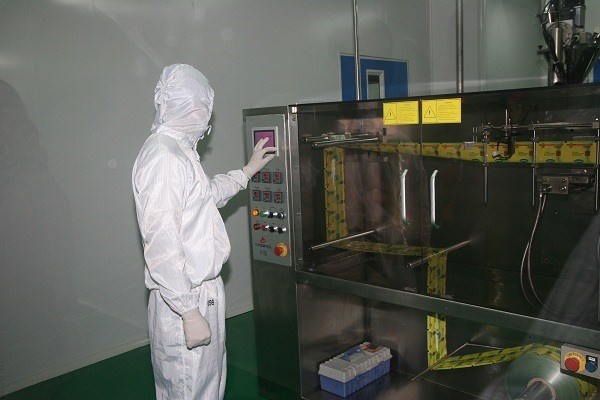
 A worker mans a dietary supplement manufacturing line (Photo: suckhoedoisong.vn)
Hanoi (VNS/VNA) – More than 90 percent of
in Vietnam have not implemented (GMP), according
to health officials, leading to fears that without gaining GMP certificates by
July next year, their production would be halted.
Nguyen Thanh Phong, head of the Food Safety Department under Health Ministry,
said according to incomplete statistics, there were about 4,000 dietary
supplement producers in Vietnam now but about 300 had GMP certificates – the
guidelines recommended by the Health Ministry to ensure products are
consistently high in quality and don’t harm users.
Under a Government decision issued in February, by July next year, all dietary
supplement producers in Vietnam must have GMP certificates.
The criteria for GMP certification in dietary supplement production are the
same as for medicine production, Phong said.
The requirements included those relating to infrastructure, equipment, working
conditions, staff and documents.
“Company owners or officers responsible for dietary supplement production must
undergo tertiary education with a major relating to the company’s products,”
Phong said.
“It is reported that many owners of dietary supplement companies don’t have
proper understanding about medicine, pharmacy and nutrition,” he added.
The Government also requires GMP manufacturers to record their operations,
especially documents on output material and quality testing.
Phong said that previously, Vietnam did not have regulations on production at
dietary supplement companies. Instead, they followed regulations for food
production.
“The lack of specific regulations for dietary supplement production caused
inequality in business climate and affected consumers’ rights and benefits,” he
said.
For example, companies with GMP certificates invested much to meet
requirements while companies without GMP certificates just rented an office, a
workshop, bought packing equipment and sold products.
“Tightened controls on dietary supplement production are expected to curb
substandard products,” he said.
Head of the HCM City Food Safety Management Board Pham Khanh Phong Lan
told Thanh Nien (Young People) newspaper that in the last few years,
Vietnam’s dietary supplement market had grown strongly.
Nearly a decade ago, only a few dozen dietary supplement products were
available. Now, there are more than 10,000 kinds of products locally made or
imported.
Increased consumption of dietary supplements showed that people invested more
in health, she said.
“The increase in demand leads to the increase in supply, following market
rules. But improper control by Government bodies resulted in problems such as
substandard products, fake products and uncontrolled prices,” she said.
Lan said that technical standards like GMP should have been used to control the
quality of dietary supplement much earlier. The Health Ministry has extended
the deadline for manufacturers to implement GMP many times previously.
“It’s time to tighten control on , both domestic and
imported,” Lan said.
She also reassured the public that supply would still meet demand in case
non-GMP manufacturers close. Now, many GMP manufacturers are operating under
their designated capacity because of unhealthy competition caused by
substandard firms.
“When GMP manufactures can operate at full capacity or they can outsource their
products, supply can meet demand,” she said.-VNS/VNA
Source: VietnamPlus


