

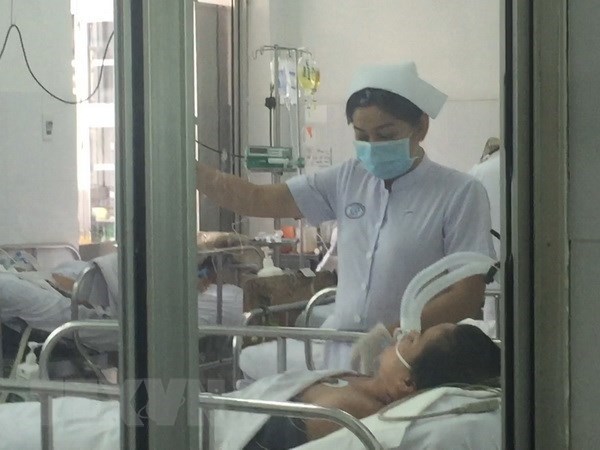
 A patient infected with influenza A/H5N1 receive treatment (Photo: VNA)
Vaccines and Medical Biologicals (IVAC) has completed the clinical trials of
two types of , which are expected to receive approval
for commercial use in 2019, said Dr Le Van Be, head of the institute.
The vaccine targets three strains of influenza:
A/H1N1, A/H3N2 and B/H3N2, along with A/H5N1 (avian influenza or bird flu).
The results were recorded after nine years of
international cooperation with Vietnam’s Ministry of Health (MoH) and the IVAC to
improve the country’s vaccine production and pandemic influenza response.
Since 2010, PATH (known as Programme for
Appropriate Technology in Health) – an international, non-profit global health
organisation – has worked with the MoH to devise a long-term plan on influenza
vaccine production and consumption, as well as guidance on clinical trials and
vaccine registration.
Over the 2017-2018 period, the second phases of
the vaccine trials for seasonal influenza and A/H5N1 were completed, paving the
way for the vaccines to be licensed for commercial use.
Notably, the price of the vaccines will be only
one third of imported ones, standing at 80,000-120,000 VND (3.5-5 USD) per
dose.
According to IVAC, at a seminar on seasonal
influenza in Vietnam which took place in late August, Deputy
Health Minister Nguyen Thanh Long announced that locally produced seasonal
influenza vaccines had received their first order from the World Health
Organisation (WHO), making Vietnam among the 14 countries supplying the
preventative treatment.
Influenza is a leading cause of low morbidity
and mortality worldwide. Seasonal influenza causes some 250,000-500,000
fatalities and up to five million cases of severe illness across the globe
every year.
If a highly virulent pandemic strain emerged,
influenza could cause millions of fatalities around the world.
Vietnam reports more than a million cases of
influenza-like illnesses every year and has reported isolated cases of avian
influenza A/H5N1 in humans, a strain with a particularly high fatality rate.
The strain is being monitored for any evolution
or adaptation that could turn it into an easily-spread form, bolstering against
the likelihood of a pandemic.
The , established in 1978 by the MoH, plans
and carries out the production of vaccines and serums for the Expanded
Programme on Immunisation in Vietnam and the overall prevention and treatment
of diseases. It also conducts research and applies technological advances in
vaccine development and production in cooperation with organisations both inside
and outside the country. –VNA
Source: VietnamPlus


