

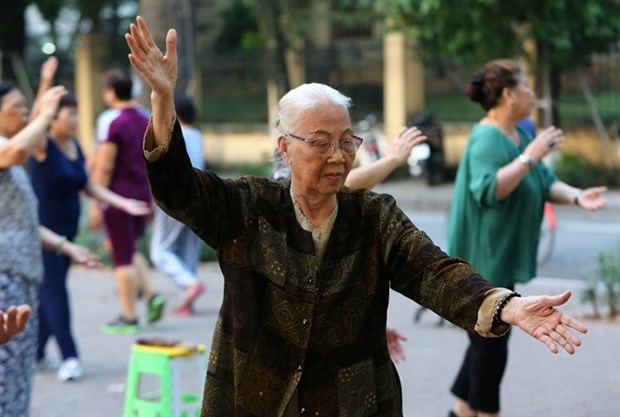
 Old women do morning exercises at Hoan Kiem Lake. As the Vietnamese population gets older, more money needs to be spent on health, experts said (Photo: VNA)
Hanoi (VNS/VNA) – Global trends in
health policies and practical access in the context of the rapidly aging
population were topics of discussion at a forum on health care on November 13
in Hanoi.
The forum was titled “Paving the path for the
future in healthcare: Driving efficiency and outcomes in a ”
and was organised by the Vietnam Medical Association and Novartis Vietnam. It
drew the participation of dozens of healthcare policymakers and academic
leaders in the healthcare sector from across Asia.
According to Amos Garcia from Singapore’s Milken
Institute, the challenges of were enormous as older people are
increasing in number.
Research by the institute showed that Asia was
ageing faster than it was gaining wealth.
The Healthcare sector’s share of GDP has been
rising in East Asia and the Pacific with income growth, he said.
Speaking at the forum, Nguyen Van Tien, former deputy
head of the National Assembly’s Committee for Social Affairs, said Vietnam is
among the countries with the fastest growing aging populations in Asia.
While developed countries like France takes 115
years to transform from an ageing population into an old or aged population,
the process only takes 18 years for Vietnam.
As the Vietnamese population ages, more money
would be spent on healthcare, he said, adding that health expenditure accounted
for 5.7 percent of its GDP in 2015.
The number of dependent elderly people who need
care was increasing while the population of young labourers paying taxes was
reducing.
Tien said the burden on the health system would
only grow as the population gets older.
He proposed re-orienting the system to respond
to an increase in non-communicable diseases and the ageing population.
Universal healthcare coverage for people of all ages would be continued as will
the development of private health services.
To overcome the negative impacts of an ageing
population, Garcia said it was necessary to redefine traditional notions of
ageing. This includes reinforcing the message that older adults are valuable to
society. A top-down corporate culture that recognizes the wisdom, knowledge and
opportunities of older workers should be emphasised.
Another solution was to provide opportunities
for meaningful and productive experiences and focus on long-term wellness and
disease prevention, he said.
He underlined the need to remove age-related
institutional barriers to social participation.
Regarding challenges to universal health
coverage, Le Van Kham, Director of the Health Insurance Department under the
Vietnamese Ministry of Health, said 13 percent of the population was uninsured.
The rate of out-of-pocket spending was at 40 percent, but World Health
Organisation recommendations saidit should be less than 30 percent.
He said “limited financial resources mean
that resources are not always used efficiently”.
The capacity of health service provisions was
weak, especially at the provincial level, which limited benefits for
beneficiaries, increasing costs for patients, Kham said.
To solve these difficulties, he suggested a
dissemination campaign and making benefits more favourable for health insurance
holders.
Prastoeti Soewondo from office of the vice
president of the Republic of Indonesia served as a member of the supervisory
board of the National Social Health Insurance Agency until 2015 and now sits on
the country’s health working group. She said remarkable results had been
achieved since the integration of the health insurance scheme into single payer
– JKN (Jaminan Kesehatan Nasional), a scheme operated by Badan Panyelenggara Jaminan
Sosial Kesehatan (BPJS) in 2014.
Under JKN, a government-subsidised scheme, all
citizens are able to access a wide range of health services provided by public
facilities, and services from a few private providers that opted to join the
scheme.
Analysts have pointed out that from 2013 to
2016, the utilisation of both outpatient and an inpatient services is
consistently higher among JKN members compared to uninsured people. From 2013
to 2016, inpatient utilization for JKN member increased by 68.7 percent and in
2016 was 1.6 more than that of the uninsured, she said.
Reforms in payment systems and the drug supply
chain resulted in a comprehensive benefit package with almost all diseases
covered, Soewondo said.
“Universal coverage is ‘beyond treatment,’” she
said. “It should be a holistic approach embedded in a strong health care
system.”
Participants at the forum agreed that patient
should be the centre of the and community. They said the public
and patients should be engaged in disease prevention and management.
Given the increasing challenges in the health
care system, new technologies and digitalisation should be adopted to enhance
the quality of patient care and enable sustainable development, they
said.-VNS/VNA
Source: VietnamPlus


