

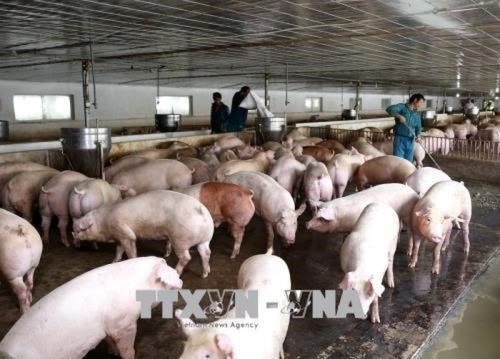
 As the threat of African Swine Flu entering Vietnam rises, preventive measures such as close monitoring, culling, and inspections are being deployed. Illustrative image (Source: VNA)
working with authorities to prevent the infiltration of the fast-spreading
into Vietnam.
African
Swine Flu (ASF) is a contagious disease which affects pigs. Although not
dangerous towards humans, the near 100 percent mortality rate, ease of spread
and the makes the diseases very deadly.
The
disease, which has no cure, has affected 19 countries. In China, from August to
November, more than 70 cases of infection were detected.
Nguyen
Van Long, head of the epidemiology department of the Department of Animal
Health, said that Vietnam faced a high risk because of the transporting and
smuggling of pork products of unclear origin from regions affected by ASF
(especially in the s).
In
November, the Ministry of Agriculture and Rural Development issued an emergency
action plan to deal with the rising threat of ASF entering Vietnam, especially
as the disease in China began moving southward.
Inspection
teams were formed in provinces that are along the border, have a high
concentration of pigs, or have a high number of visiting tourists.
Closer
monitoring is being employed to combat smuggling, selling and gifting of pork
and pigs of unclear origin, while processed pork products bought from countries
with ASF are being examined thoroughly.
Imports
of pork from countries with ASF have been suspended, while farms, markets and
slaughterhouses are expected to be frequently sterilised.
In
addition, farms have to apply strict bio-security standards, with vehicles or
people properly sanitised before entering or leaving farms.
Properly
equipped labs to test for ASF from pig samples have also been set up.
Farmers
and veterinarians are monitoring ASF to detect if there are signs of possible
ASF, pork products of unknown origin, or pigs dying of unknown causes.
They
are also expected to retrieve samples for testing before disposing of the pigs
or pork products.
Authorities
have been told to inform the public of the danger and development of ASF.
If
ASF is detected at a farming household, the entire herd has to be disposed of
within 24 hours after the announcement of the results.
If
the disease is detected at a large pig farming facility with sectioned barns,
the infected barn will be culled. The entire facility must cull its pigs if
signs of spread are found.
Towns
and wards with infected households will also be quarantined if needed. If pigs
with symptoms are found within three kilometres, they have to be culled within
48 hours without the need for testing to prevent the spread of the disease.
Transportation
of pigs in and out of infected towns and wards is prohibited, and surrounding
areas have to be closely monitored and sanitised. Authorities will compensate
farmers for their loss of pigs.
A
representative from Boehringer Ingelheim, one of the world’s leading
pharmaceutical companies, said that its Comprehensive Online Management
Biosecurity Assessment Tool could be used to check a pig farm’s biosecurity
level.
To
combat ASF, Vietnam plans to spend nearly 49 billion VND (2.1 million USD)
until the end of 2019 to purchase equipment and carry out inspections, training
drills and research.-VNS/VNA
Source: VietnamPlus


